

A repair can have several different “times” attached to it—and they are not interchangeable.
There is book time, the standardized labor allowance used to estimate a defined operation. There is actual technician time, the time recorded while a technician works on the job. There is elapsed shop time, which may include waiting for parts or customer authorization. And there is billed labor, the labor the customer authorized and the shop charged.
Confusing those measurements creates bad estimates, misleading productivity reports, and difficult customer conversations. Tracking them separately gives a repair shop a much clearer view of what was quoted, what happened in the bay, and what should improve next time.
Quick answer: Book time is an estimating standard for a defined repair operation. Actual time is the technician time recorded against that work. A shop can use book time to quote consistently and actual time to review job performance, but neither number should automatically replace the other.
If you are looking for the broader foundation—how shops measure labor time and use labor guides—start with ARI's Ultimate Guide to Auto Repair Labor Times. This article focuses specifically on comparing the planned time with what actually happened.
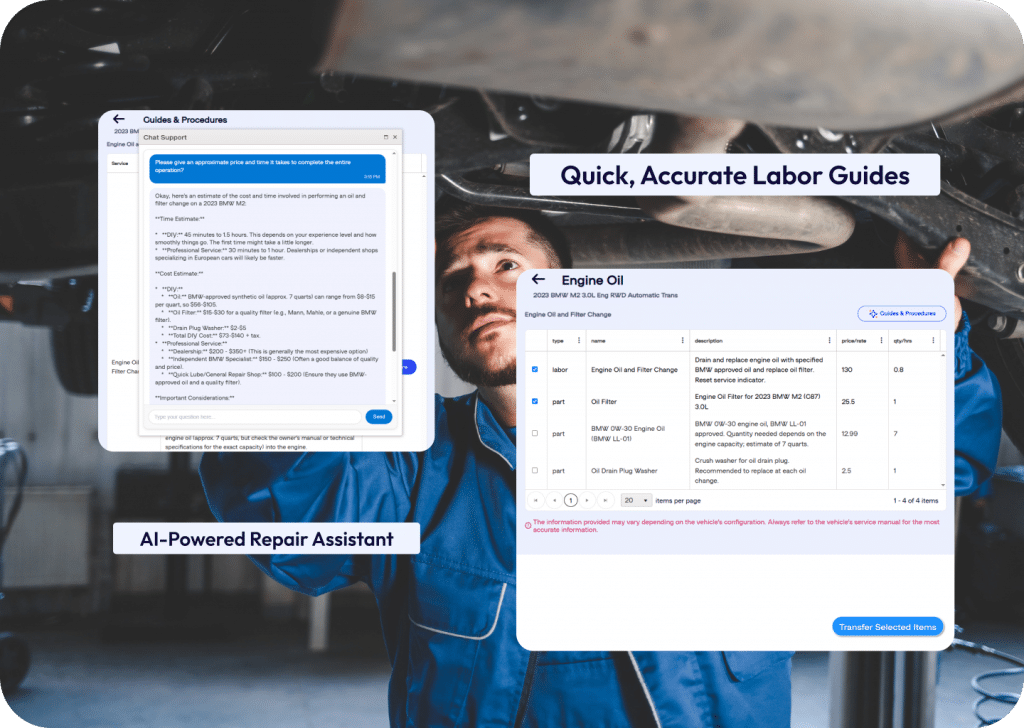
A labor guide supplies an estimating baseline. Time tracking shows how the individual job performed under real shop conditions.
Book time, technician time, elapsed time, and billed labor
Before comparing the numbers, define exactly what each one measures.
| Measurement | What it means | Primary use |
|---|---|---|
| Book time | A standardized labor allowance for a defined operation on a specified vehicle | Estimates, scheduling, and consistent quoting |
| Actual technician time | Time recorded while a technician is assigned to and working on the job | Job costing, coaching, and process review |
| Elapsed shop time | Total time from vehicle arrival to completion or delivery | Cycle-time and customer-experience analysis |
| Diagnostic time | Time spent identifying the cause and confirming the repair | Diagnostic authorization and job costing |
| Billed labor | Labor hours authorized and charged for the completed scope | The estimate and final invoice |
One vehicle might spend two days at a shop even though the repair required only three hours of technician time. It may have waited for a part, customer approval, a sublet service, or an open bay. Treating those two days as “actual repair time” would produce a useless comparison.
A simple book-time-versus-actual-time example
Suppose a labor guide lists 2.4 hours for a confirmed repair. At a hypothetical shop labor rate of $135 per hour, the estimated labor charge is:
2.4 book hours × $135 = $324 estimated labor
The technician records 1.9 actual hours against the repair and completes the required procedure correctly.
That result does not automatically mean the customer should be charged only 1.9 hours. In a flat-rate workflow, the approved labor charge is based on the defined operation and the shop's estimating policy, subject to the written estimate and applicable law. The 1.9-hour result is operational data the shop can use to understand the job.
Now consider the same repair on a vehicle with severe corrosion and previously damaged hardware. The technician records 3.3 actual hours. That does not automatically mean the customer can be charged 3.3 hours. Work outside the original operation should be inspected, documented, explained, and authorized according to the rules that apply to the shop.
The comparison informs the decision; it does not replace authorization.
Why book time and actual time differ
Book time standardizes an operation. Actual time reflects one technician, one vehicle, and one set of shop conditions.
Vehicle condition
Corrosion, seized fasteners, damaged threads, contamination, brittle connectors, collision damage, and heavy buildup can make an otherwise ordinary operation take longer.
Previous repairs and modifications
Aftermarket equipment, non-original hardware, wiring changes, missing shields, altered exhaust components, and incorrect prior repairs can change access and procedure.
Exact vehicle configuration
Engine, drivetrain, trim, production date, driver-assistance equipment, and optional components can affect the operation. Selecting the wrong configuration can create a false comparison before the repair even starts.
Diagnostic uncertainty
Replacing a confirmed failed component is different from finding an intermittent electrical, drivability, or network fault. Diagnostic time should be identified rather than hidden inside a replacement allowance.
For electrical work, the test process is often more important than the replacement time. ARI's guide to reading automotive wiring diagrams explains how to turn a schematic into an ordered diagnostic plan.
Technician experience and equipment
Familiarity with the platform, training, scan tools, lifts, special tools, service information, and bay organization all affect actual time. A technician can finish below book time without skipping a required step. Another technician may need longer while still completing the repair correctly.
Included operations and labor overlap
A labor allowance may already include certain access work, while diagnosis, programming, alignment, calibration, fluid service, or road testing may be separate. Two repairs can also share teardown. Reading operation notes prevents both missing labor and charging twice for the same work.
Finishing below book time is not automatically a problem
When actual time is lower than book time, ask why before drawing a conclusion.
A favorable difference may come from:
- Experience with that exact vehicle or repair
- The correct special tools being ready
- Strong parts preparation and bay organization
- A clean vehicle with no complications
- Shared access work across authorized operations
- An efficient diagnostic handoff
The objective is not to make every technician clock exactly the guide time. The objective is to complete the authorized repair correctly, safely, and consistently.
Taking longer than book time is not automatically a technician problem
The opposite difference also needs context. Actual time may exceed book time because:
- The wrong labor operation or vehicle configuration was selected
- The initial diagnosis was incomplete
- The vehicle had corrosion, damage, or modifications
- A required tool or part was unavailable
- The technician was interrupted or reassigned
- Waiting time was left on the active clock
- The operation notes or additional procedures were missed
- Training or technical support was required
A time report without those explanations can punish the wrong person and leave the real bottleneck unfixed.
How repair shops should track actual technician time
Useful time data depends on consistent clocking rules.
Start the clock against a specific work item
“Working on the vehicle” is too broad. Tie time to the labor item or repair operation whenever the system allows it. That makes the comparison with the estimate meaningful.
Separate diagnosis from confirmed repair work
If a technician spends time testing before the failed component is confirmed, record that as diagnosis. Otherwise, a replacement operation can appear inefficient even when most of the time was spent finding the fault.
Stop active repair time during long waits
Waiting for authorization, parts, sublet work, or technical information affects cycle time, but it is not necessarily active technician time. Track those delays separately rather than letting them inflate the repair clock.
Record who performed the work
Technician-specific time helps a shop understand training needs, specialties, handoffs, and workload. It also prevents one person's time from being attributed to another.
Add short exception notes
“Seized lower fastener,” “aftermarket wiring required tracing,” or “vehicle configuration corrected after inspection” gives the variance meaning. A raw number cannot explain itself.
Review patterns instead of isolated jobs
One unusual repair is not a policy. Look for repeated differences across the same operation, vehicle family, technician, or type of delay. Patterns reveal whether the estimate, workflow, training, tooling, or clocking discipline needs attention.
A practical variance-review workflow
Use the same short process during a weekly or monthly job review:
- Confirm the estimate: Was the correct vehicle and labor operation selected?
- Compare planned and actual time: What was the numerical difference?
- Remove non-working delays: Were approval, parts, or sublet waits left on the active clock?
- Read the job notes: Was there corrosion, damage, modification, or an unexpected procedure?
- Check the handoff: Was the failure confirmed before repair work started?
- Look for repetition: Has the same variance appeared on similar jobs?
- Choose one response: Improve estimating, tooling, training, parts staging, authorization, or clocking discipline.
Avoid turning every variance into a labor-price adjustment. Sometimes the correct response is operational: move a tool closer, stage parts earlier, clarify diagnosis, or choose the correct labor operation.
Metrics that answer different shop questions
Different measurements should remain separate because they answer different questions.
| Shop question | Measurement to review |
|---|---|
| Did we quote the defined repair consistently? | Book hours and authorized billed labor |
| How much technician time did the work consume? | Actual technician hours |
| Why was the vehicle here for two days? | Elapsed shop time and delay reasons |
| Are we identifying faults efficiently? | Diagnostic time and test-path notes |
| Does this operation repeatedly exceed the estimate? | Variance across comparable completed jobs |
| Is a process change working? | Before-and-after variance across multiple jobs |
This separation also improves customer communication. A customer asking why the vehicle stayed overnight is asking about elapsed time. A shop reviewing technician utilization is asking about recorded work time. Those are not the same report.
How to explain book time to customers
Customers sometimes assume that an hourly labor rate means a stopwatch is running against every dollar. A concise explanation can prevent confusion:
“The labor charge is based on the standard allowance for the approved repair on your vehicle, multiplied by our labor rate. We also track the technician's time internally so we can improve our estimating and workflow. If inspection reveals additional work outside the approved operation, we will contact you before proceeding.”
Do not promise that every repair will take exactly the guide time. Explain the approved scope, what the allowance covers, and how the shop handles unexpected conditions.
How ARI can connect planned and actual labor
ARI's AI Labor Guides and Estimates help shops review vehicle-specific parts and labor information and transfer selected items into an estimate, invoice, or Job Card.
For actual-time tracking, ARI can attach a technician-specific Time Clock to an item inside a Job Card. After parts or labor items have been added, the shop selects an item, assigns the technician, and starts the clock from that assignment flow. When work stops, the recorded duration remains with the Job Card and can be used to review or update labor time.
That creates two useful records:
- The planned labor used to prepare the estimate
- The recorded time associated with the individual job
AI-generated or third-party labor information still needs professional review. Confirm the exact vehicle and operation, read included-work notes, and verify safety-critical procedures and specifications against authoritative service information.
Frequently asked questions
What is mechanic book time?
Mechanic book time is a standardized labor allowance for a defined repair or maintenance operation on a specified vehicle. Shops use it as an estimating and scheduling baseline.
Is book time the same as actual repair time?
No. Book time is a standard used for planning and estimating. Actual time is what the shop records while the technician performs the work. Vehicle condition, diagnosis, tools, experience, and shop interruptions can make actual time shorter or longer.
Is actual technician time the same as elapsed shop time?
No. Technician time records active work. Elapsed shop time can include overnight storage, parts delays, customer authorization, sublet work, or waiting for an available bay.
Should customers be charged actual time or book time?
That depends on the shop's estimating method, the approved scope, its written policies, and applicable law. In a flat-rate workflow, the approved charge is commonly based on a defined labor allowance rather than the technician's elapsed minutes. Additional work should be documented and authorized.
Does book time include diagnosis?
Not necessarily. A replacement allowance may assume the failed component has already been identified. Review the operation details and authorize diagnostic work separately when the cause is not confirmed.
What if actual time repeatedly exceeds book time?
Review several comparable jobs. Check vehicle selection, operation notes, diagnosis, condition, tools, parts staging, technician familiarity, interruptions, and clocking rules before changing the estimate or judging performance.
Can actual time be used to improve future estimates?
Yes. Repeated, well-documented differences can reveal missing operations, local condition patterns, process delays, or training needs. Use comparable jobs and exception notes rather than changing an estimate because of one unusual repair.
The bottom line
Book time and actual time are both useful because they measure different things.
Use book time to create a consistent starting point for the authorized repair. Use actual technician time to understand what happened in the bay. Keep elapsed delays and diagnosis visible, document exceptions, and review patterns across multiple jobs.
The goal is not to force every repair to match a labor guide exactly. It is to produce clearer estimates, more useful operational data, and fewer surprises for both the shop and the customer.
For the broader labor-time foundation, revisit ARI's Ultimate Guide to Auto Repair Labor Times. To connect labor-guide information with job-level tracking, explore ARI's AI Labor Guides and Estimates.