

Account Credit: Keep Money on File for Your Customers
Every shop runs into this. A customer overpays an invoice. You owe someone a refund, but they’d rather just “leave it on my account for next time.” You want to make good on a job that ran late by knocking something off on their next visit. Until now, ARI (Auto Repair Software) had no clean way to handle any of it — every payment had to be attached to an invoice, and there was nowhere to simply hold money for a customer.
Account Credit fixes that. It lets you keep a running balance of money on a client’s account that draws down against their future invoices — and it keeps a complete, permanent record of every dollar in and out
What Account Credit Actually Is
Account Credit is a balance of money a client has on file with your shop — think of it like a gift-card balance. Two things it is not, and it helps to be clear on both:
- It is not a discount. A discount lowers the price of a job. Account Credit is a real value the customer already has — it pays a normal-priced invoice down, exactly like cash or a card.
- It is not cash in their hand. It’s a balance they can only spend with you, on future work.
Behind the balance, ARI keeps a full ledger — every credit added, applied, or reversed is a permanent line item with a date, an amount, a reason, and who did it. You can always answer the question “Where did this balance come from?”
When You’d Use It
- Refund without cash back — a customer overpaid, returned a part, or cancelled a job, and you both agree to leave the money on their account instead of refunding their card.
- Goodwill / make-good — a job ran late, needed a re-do, or had a warranty hiccup, and you want to compensate the customer toward their next visit.
- Overpayment capture — a customer simply pays more than the invoice total, and you keep the extra as credit.
- Loyalty or a promotion — a reward you choose to grant a repeat customer.
How to Use It
Finding it
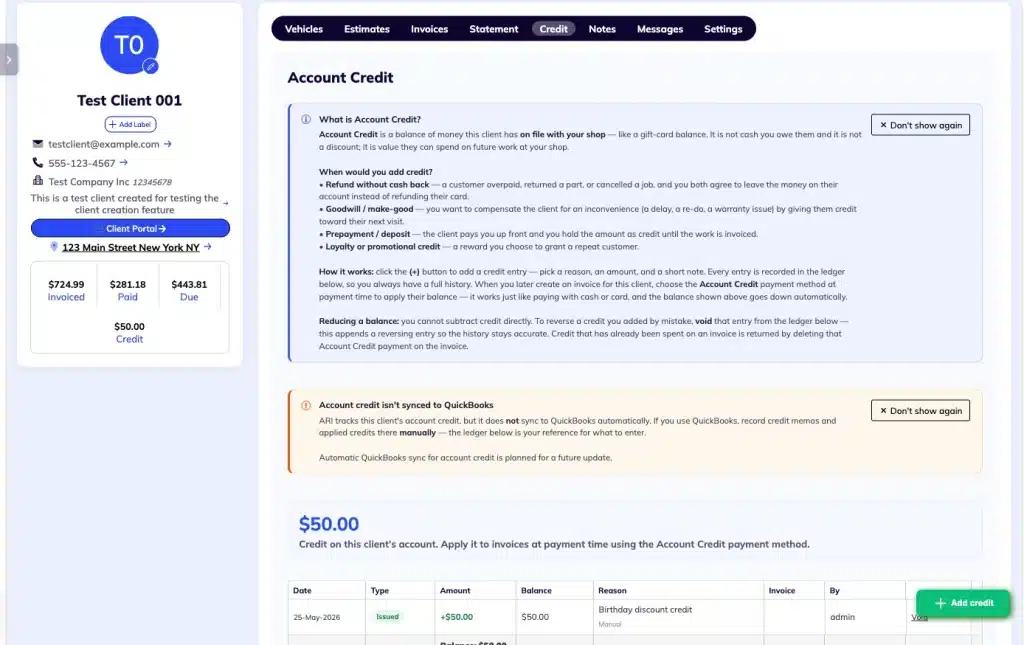
Open any client and look for the new Credit tab, alongside Vehicles, Estimates, Invoices, and Statements.
Adding credit
On the Credit tab, tap the + Add credit button. Pick a reason (refund, goodwill, a manual entry, or a correction), enter the amount and a short note explaining it, and tap Add Credit. The entry drops into the ledger immediately, and the balance updates.
Spending credit
When you take a payment on an invoice, choose Account Credit as the payment method. ARI automatically caps the amount at the lower of the invoice’s balance due and the customer’s available credit, so you can’t overspend. Save the payment — the invoice is paid down just like it was paid by cash or card, and the client’s balance drops automatically.
Proactive Alerts: ARI also offers it to you proactively: start a payment for a client who already has a balance, and ARI will ask whether you’d like to apply their credit — no need to remember it yourself.
Capturing an overpayment
If a customer pays more than an invoice’s total, ARI notices and offers to convert the overage into account credit.
- Accept: ARI does something important quietly: it makes sure the invoice settles to exactly its total, records the extra as credit, and still records the full amount of cash you actually collected — your payment totals and bank deposit always match.
- Decline: The invoice simply stays overpaid, the way it always has.
Fixing a mistake
Added a credit you shouldn’t have? Void that entry from the ledger — ARI appends a reversing entry rather than erasing anything, so your history stays accurate and auditable. Need to return credit a customer already spent on an invoice? Just delete that Account Credit payment on the invoice, and the credit goes back onto their account.
Where the Balance Shows Up
The current balance appears in three places:
- On the client card, next to Invoiced, Paid, and Due
- In the header of the Credit tab
- At the bottom of the ledger grid
A Few Things to Know
- QuickBooks: Account Credit is tracked inside ARI but is not synced to QuickBooks automatically. If you keep your books in QuickBooks, record the matching credit memos and applied credits there manually — your Credit-tab ledger is the exact reference for what to enter. When QuickBooks is connected, ARI shows a reminder banner on the Credit tab, so this never slips.
- Reducing a balance: You can’t subtract credit directly. To lower a balance, void an entry from the ledger.
- Editing: An Account Credit payment can’t be edited after the fact — delete it and create a new one if something needs to change.
- Bulk payments: Account Credit isn’t available in multi-invoice (bulk) payment mode — apply it one invoice at a time.
- Deleting a client: A client who still has a credit balance can’t be deleted until that balance is cleared (so you never lose track of money owed to a customer).
- Permissions: Adding or voiding credit follows your existing “create payments” permission; anyone on the team can view the Credit tab.
What’s Next
Today, Account Credit is applied by your team inside ARI. Letting customers apply their own credit when they pay an invoice online through the Client Portal is on our roadmap — stay tuned.
Find it: Client page → Credit tab.