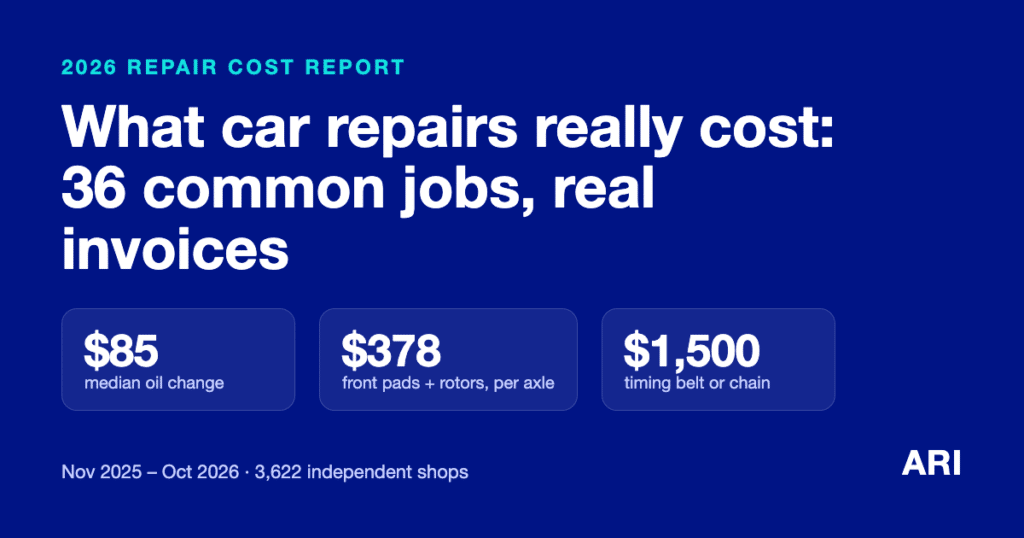
“How much should this cost?” Every driver asks it at the counter, and every shop owner asks it when writing the estimate. Most price guides answer with national averages pulled from surveys or quotes. We went to the source: the invoices auto repair shops actually sent their customers.
We analyzed 556,458 invoices from 3,622 independent auto repair shops across the United States that run on ARI, from November 2025 to October 2026. Below you will find what 36 of the most common jobs cost (parts and labor together), how long they take, at what mileage cars need them, which repairs customers put off, and when in the year each job gets busy.
Key takeaways
- Everyday maintenance is affordable; big engine jobs are not. A median oil change cost $85. A timing belt or chain job had a median of $1,500, and a head gasket $2,251.
- The same job can cost twice as much on a different car. For a typical job, the pricier quarter of invoices started at more than double what the cheaper quarter topped out at.
- Cars at independent shops are old. The typical car in for a repair was 12 years old, and most major repairs happen past 120,000 miles.
- Customers rarely say no to repairs that keep the car running. They postponed only 3% of recommended starter jobs, 3% of alternator jobs and 5% of fuel pump jobs, against 17% of catalytic converter jobs and 14% of oil pan gasket jobs.
- Repair work has seasons. A/C jobs run about 7 times busier in July than in January, and battery replacements are about 41% busier from November to January than from April to June.
Look up a repair
Pick a job to see what it typically costs, how long it takes and when cars usually need it.
Pick a job above. If nothing appears, your browser is blocking scripts; the price tables below have the same numbers.
What common car repairs cost in 2026
Each row shows the price range for the middle half of invoices (the bar) and the median price (the dot), including parts and labor, before tax. The scale grows by multiples so that a $30 flat repair and a $2,000 head gasket fit on the same chart. Hover over or tap a job for its numbers.
Repair prices by system
The same numbers as tables, grouped by what part of the car the job is on. “Labor hours” is the typical time billed; “parts share” is how much of the bill went to parts.
Maintenance
| Job | Median price | Middle half | Labor hours | Parts share |
|---|---|---|---|---|
| Oil change | $85 | $67–115 | 1.0 | 52% |
| Transmission fluid service | $282 | $186–451 | 1.1 | 44% |
| Coolant flush | $230 | $166–319 | 1.2 | 33% |
| Brake fluid flush | $150 | $118–213 | 1.0 | 25% |
| Spark plug replacement | $306 | $199–473 | 1.4 | 45% |
| Serpentine belt replacement | $200 | $130–320 | 1.0 | 43% |
| Timing belt or chain | $1,500 | $935–2,278 | 8.0 | 40% |
Brakes
| Job | Median price | Middle half | Labor hours | Parts share |
|---|---|---|---|---|
| Front brake pads (per axle) | $185 | $120–289 | 1.0 | 42% |
| Rear brake pads (per axle) | $195 | $125–294 | 1.0 | 39% |
| Front brake pads and rotors (per axle) | $378 | $261–490 | 1.2 | 55% |
| Rear brake pads and rotors (per axle) | $381 | $280–502 | 1.4 | 53% |
| Brake caliper replacement | $292 | $187–449 | 1.2 | 51% |
Starting and charging
| Job | Median price | Middle half | Labor hours | Parts share |
|---|---|---|---|---|
| Battery replacement | $295 | $201–405 | 1.0 | 61% |
| Alternator replacement | $464 | $288–640 | 1.5 | 54% |
| Starter replacement | $375 | $250–500 | 1.4 | 46% |
Cooling
| Job | Median price | Middle half | Labor hours | Parts share |
|---|---|---|---|---|
| Water pump replacement | $578 | $394–870 | 2.7 | 39% |
| Radiator replacement | $535 | $350–747 | 2.0 | 46% |
| Thermostat replacement | $290 | $206–429 | 1.5 | 37% |
Engine and fuel
| Job | Median price | Middle half | Labor hours | Parts share |
|---|---|---|---|---|
| Ignition coil replacement | $227 | $153–390 | 1.0 | 51% |
| Valve cover gasket | $394 | $250–625 | 2.2 | 30% |
| Oil pan gasket | $476 | $344–735 | 2.5 | 32% |
| Fuel pump replacement | $525 | $321–721 | 2.0 | 46% |
| Head gasket | $2,251 | $1,384–3,213 | 11.5 | 38% |
Suspension and steering
| Job | Median price | Middle half | Labor hours | Parts share |
|---|---|---|---|---|
| Wheel alignment (usually four-wheel) | $100 | $85–132 | 1.0 | 27% |
| Struts or shocks | $427 | $255–706 | 1.8 | 51% |
| Control arm or ball joint | $409 | $276–620 | 1.8 | 43% |
| Tie rod end | $250 | $172–427 | 1.2 | 44% |
| Sway bar link | $190 | $140–262 | 1.0 | 42% |
| Wheel bearing or hub | $386 | $268–554 | 1.8 | 46% |
| CV axle replacement | $395 | $280–653 | 1.8 | 48% |
Air conditioning
| Job | Median price | Middle half | Labor hours | Parts share |
|---|---|---|---|---|
| A/C recharge | $183 | $132–300 | 1.0 | 34% |
| A/C compressor replacement | $659 | $400–889 | 2.2 | 52% |
Exhaust and emissions
| Job | Median price | Middle half | Labor hours | Parts share |
|---|---|---|---|---|
| Oxygen sensor replacement | $212 | $143–314 | 1.0 | 50% |
| Catalytic converter | $765 | $382–1,254 | 2.0 | 64% |
Diagnostics and tires
| Job | Median price | Middle half | Labor hours | Parts share |
|---|---|---|---|---|
| Diagnostic (diagnostic fee) | $120 | $75–168 | 1.0 | 25% |
| Flat tire repair | $30 | $16–79 | 1.0 | 39% |
What brings cars into the shop
Ranked by the share of all invoices that include the job. The top three, oil change, diagnostic and inspection or emissions test, are how most customer relationships start. The bigger repairs come later, from the same customers.
Share of 556,458 invoices that included each job. One invoice can include several jobs.
When cars need these repairs
The typical mileage and vehicle age when each repair was done. Most major repairs happen well past 100,000 miles, on cars more than a decade old. Radiators, tie rods, starters and alternators come latest, at around 155,000 to 160,000 miles. Brake work comes earlier and keeps coming back.
Median odometer reading on the invoice, and the vehicle’s typical age in years when the work was done.
Yes, or not now: the repairs customers postpone
When a shop recommends work, customers approve some jobs almost every time and postpone others. The pattern is clear: if the car will not start or run without the repair, people say yes. If the car still drives, more of them wait.
Share of recommended jobs that customers declined, at the shops that record declined work in ARI, among jobs recommended at least 500 times: the 10 most and 10 least postponed.
The seasons of the repair shop
Some jobs follow the weather. Darker cells mark busier months. A/C repairs climb from spring and peak in July. Batteries, thermostats and coolant work pick up in the cold months, when weak parts finally fail.
Each job’s share of all repair work by calendar month, compared with its average month, using invoices from 2023 to 2026.
Did repair prices go up this year?
For most jobs, yes. Comparing the same shops one year apart, 22 of 29 jobs got more expensive, and the typical job rose about 9%. Part of that is higher labor rates; part is higher parts prices. We do not show a figure for each job, because a single job’s price can move with the mix of vehicles that came in, not only with prices.
Change in median price at shops that did the same job in both periods, 12 months to October 2025 vs. 12 months to October 2026, for the 29 jobs with enough invoices in both years.
What this means for your shop
- Quote with ranges in mind. The spread inside every job is wide. Customers who have seen a single “average price” online often expect the bottom of the range; showing what drives the price on their car helps.
- Make the most of everyday visits. Oil changes, diagnostics and inspections bring most cars in. A clear inspection with photos is where later repairs get found and approved.
- Follow up on postponed work. Repairs that can wait are the ones customers put off. Keep them on the vehicle’s record and follow up, so the work comes back to you when the customer is ready. See how deferred work in ARI keeps declined repairs tied to each vehicle.
- Plan for the seasons. Stock A/C parts and refrigerant before summer, and test batteries in the fall.
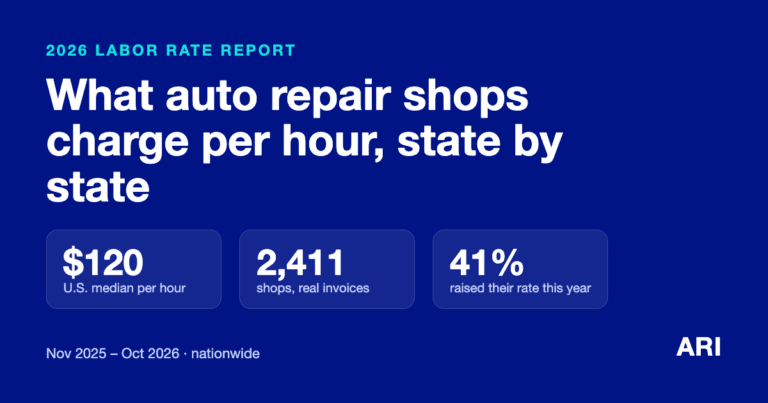
- Know your labor rate. Labor is around half of most repair bills. See how your hourly rate compares in our auto repair labor rates by state report.
Frequently asked questions
How much does a brake job cost in 2026?
At independent repair shops using ARI, replacing front brake pads and rotors had a median price of $378 per axle (parts and labor) from November 2025 to October 2026, and half of jobs cost between $261 and $490. Front pads alone had a median of $185.
How much is an oil change at an independent shop?
The median oil change at independent shops cost $85, with half of oil changes between $67 and $115. Synthetic oil and larger engines sit at the top of that range.
How much does it cost to replace an alternator?
The median alternator replacement cost $464 including parts and labor; half of jobs were between $288 and $640.
How much does a timing belt replacement cost?
Timing belt or timing chain jobs had a median price of $1,500, with half between $935 and $2,278. They are among the most labor-heavy jobs, at about 8 hours.
Why do repair prices vary so much?
The same job takes very different time and parts on different vehicles: a water pump on a four-cylinder can be a quick job, while on some V6 engines it sits behind the timing belt. Parts quality, local labor rates and what else is replaced at the same time also move the price.
How we measured this
- Data: invoices created between October 28, 2025 and October 28, 2026 from 3,622 U.S. auto repair shops with an active ARI subscription. Estimates and declined work are not counted in prices.
- Job prices: to price a job on its own, we used invoices where that job was the only labor item (117,197 invoices across the 36 jobs). The price is the labor plus all parts on the invoice, before tax. Jobs are identified from the service names shops use, so similar wording is grouped together.
- Brakes are priced per axle. Diagnostic is the diagnostic fee on its own.
- Left out: small add-on items such as wiper blades and air filters, because they are rarely invoiced on their own; tire sales, because the price depends on the tires; and state inspections, whose fees are set by law in many states.
- Postponed work covers only shops that record declined jobs in ARI. Seasons use invoices from January 2023 to October 2026.
- Privacy: every figure combines at least 75 shops and 150 invoices. No shop, customer or vehicle can be identified.
- Limits: prices are what independent shops using ARI charged. Dealer prices, parts quality and your own vehicle can put a repair outside these ranges.
Estimates customers say yes to. ARI is shop management software for auto repair shops: estimates, invoices, labor guides, inspections, deferred work and payments in one place.
Get started with ARI